






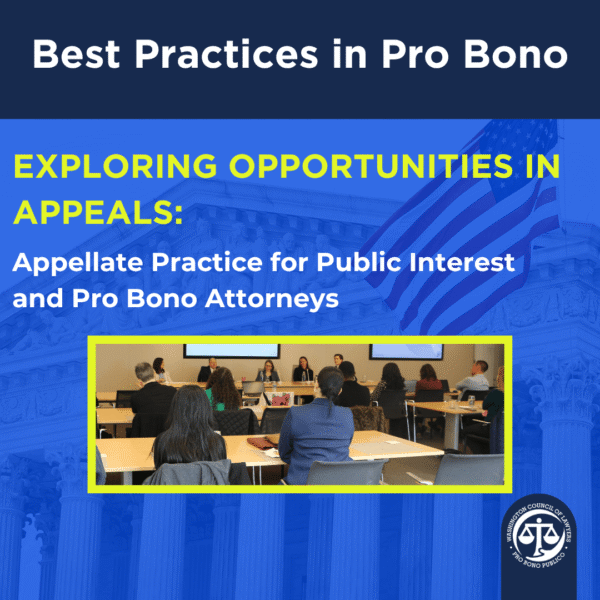
Best Practices in Pro Bono: Exploring Opportunities in Appeals: Appellate Practice for Public Interest and Pro Bono Attorneys Recap
We hosted Best Practices in Pro Bono: Exploring Opportunities in Appeals: Appellate Practice for Public Interest and Pro Bono Attorneys on Wednesday, April 22, from 12:00–1:30 p.m., with generous support from Fried Frank.
The goal of this discussion was to encourage participants to think broadly about pro bono opportunities in appellate practice. The conversation explored the wide range of appeals in which pro bono representation is needed, particularly in poverty law, and highlighted the many ways attorneys and non-attorneys can contribute to appellate advocacy. We also examined pipeline challenges in matching interested volunteers with cases and discussed strategies for incorporating appeals into pro bono programs.
The discussion began with panelists sharing their appellate experience and the pro bono opportunities available within their respective organizations. These perspectives highlighted the diversity of entry points into appellate work. Within legal services organizations, panelists described traditional appeals before the D.C. Court of Appeals, review proceedings at the trial court level that function similarly to appeals, and administrative proceedings before the Office of Administrative Hearings (OAH). From the law firm perspective, panelists emphasized the significant opportunities pro bono cases provide, including the possibility of arguing before the United States Supreme Court.
The breadth of experiences across organizations underscored the many ways both attorneys and non-attorneys can engage in appellate work. Traditional appellate cases before the Court of Appeals remain a core avenue. Additionally, trial-level review proceedings, such as when an associate judge reviews a magistrate judge’s decision, closely resemble appellate advocacy and provide further opportunities within D.C. Superior Court.
Administrative hearings also present important opportunities. These cases often arise when individuals seek to challenge changes to benefits such as Social Security or disability assistance. Proceedings are typically held before OAH, often via telephone, and may involve agencies such as the Department of Human Services or the Department of Finance. Notably, individuals do not need to be licensed attorneys to handle these cases, creating meaningful opportunities for paralegals, summer associates, and other legal professionals.
The conversation then turned to how organizations evaluate whether to place a case with a pro bono partner, highlighting the flexible and collaborative nature of appellate pro bono work. Organizations generally prioritize cases that present opportunities to clarify or develop the law. Some organizations, particularly those with narrower missions, must ensure cases meet specific eligibility criteria, while others may take a broader approach to subject matter. A key consideration is whether a case should remain in-house or be supported through a pro bono partnership.
These decisions are typically guided by three primary factors: expertise, resources, and community impact. Cases that fall within an organization’s core expertise and do not strain resources are more likely to be handled internally. In contrast, cases that require additional resources or fall outside the organization’s subject-matter expertise are often referred to pro bono partners. Organizations may also seek pro bono support for cases that are highly fact-specific and less likely to have broad systemic impact.
As with trial-level pro bono work, appellate partnerships can take many forms. Some organizations refer cases directly to pro bono counsel while remaining available for consultation. Others adopt a co-counseling model, working closely with pro bono attorneys throughout the case. Amicus (friend-of-the-court) briefs represent another significant avenue for collaboration. In some instances, organizations retain primary responsibility for a case while engaging pro bono partners to submit amicus briefs; in others, the roles are reversed.
The importance of amicus briefs, particularly at the Supreme Court level, was emphasized throughout the discussion. These briefs provide critical context about the broader implications of a case and the communities affected. Importantly, amicus briefs can influence not only decisions on the merits but also whether a case is granted certiorari. Given the rapid pace of the certiorari stage, having reliable pro bono partners prepared to contribute on short notice is essential.
Panelists also highlighted additional ways to support appellate advocacy beyond direct representation. These include legal research projects, 50-state surveys, document review, case vetting, and participation in moot courts. Organizations often rely on pro bono partners to help assess the broader legal landscape and ensure their cases align with evolving legal and policy considerations. In some partnerships, law firm paralegals assist with initial intake and screening, evaluating factors such as timing, eligibility, and client needs.
Moot court preparation was identified as particularly valuable. Practicing arguments before individuals unfamiliar with the specific legal issue can help sharpen advocacy by introducing fresh perspectives and critical questions. At the same time, input from subject-matter experts and those involved in legislative processes can provide important context and strengthen legal arguments. Panelists consistently emphasized that collaboration is essential in appellate work, particularly given the potential for cases to influence both individual outcomes and broader legal interpretations.
The discussion also addressed several challenges associated with appellate pro bono work, with timing emerging as a central concern. While organizations can monitor cases pending before appellate courts, it is difficult to track all trial-level outcomes to identify potential appeals. Strict deadlines for filing notices of appeal can create barriers, particularly for self-represented individuals. Administrative cases may move very quickly, limiting the opportunity to engage pro bono counsel, while traditional appeals can take anywhere from six months to two years and often involve extensive records.
Despite these challenges, panelists highlighted several factors that help mitigate timing constraints. Collaboration, organizational expertise, and the courts’ strong interest in ensuring representation all play important roles. Courts are often willing to grant extensions, aside from strict notice of appeal deadlines, to facilitate pro bono involvement. Additionally, established partnerships that assist with record review and case preparation can reduce the burden on pro bono attorneys. In some instances, appeals may resolve more quickly than expected, particularly in expedited contexts such as family law.
Pro bono appellate work offers significant benefits both to clients and to participating attorneys. For individuals, it helps address gaps in access to justice in a complex and often inaccessible area of law. For attorneys, particularly junior lawyers, it provides valuable opportunities to develop skills in brief writing, legal analysis, and oral advocacy. In some cases, pro bono matters can lead to rare and meaningful experiences, such as arguing before the United States Supreme Court.
Pro bono representation also supports the efficient functioning of the courts. Represented parties are generally better equipped to present legal arguments, which improves the overall quality of advocacy and judicial decision-making. Courts recognize this and may be more inclined to grant oral argument opportunities in cases involving pro bono counsel.
Key Takeaways
- Appellate pro bono work offers unique and impactful opportunities to shape both individual outcomes and broader legal principles.
- There is a significant need for pro bono representation in appellate matters, particularly in poverty law and administrative cases.
- Collaboration across organizations, law firms, and subject-matter experts is essential to effective appellate advocacy.
- Opportunities to contribute extend beyond direct representation and include research, case vetting, and moot court participation.
- Attorneys should consider both the immediate client impact and the broader legal implications when taking on appellate cases.
Engaging in appellate pro bono work provides invaluable professional development, including experience in brief writing and oral advocacy. These cases also offer the potential to influence legal doctrine in meaningful ways. Attorneys are encouraged to consult with subject-matter experts to understand how their cases fit within the broader legal landscape and to ensure their advocacy supports both their clients and the communities affected.