






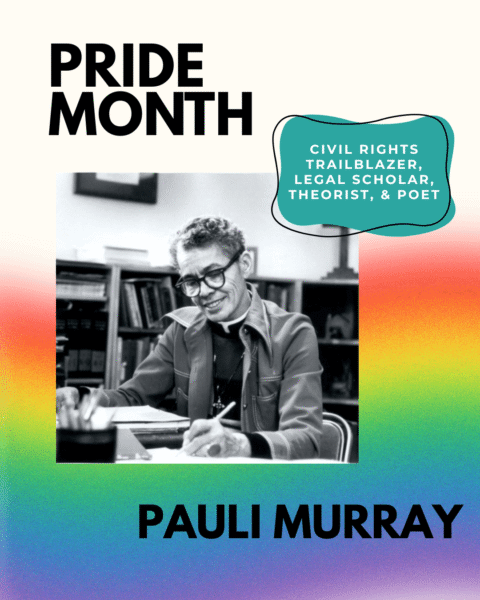
Pauli Murray – Civil Rights Trailblazer, Legal Scholar, Theorist and Poet
Pauli Murray (November 20, 1910 – July 1, 1985) was an American civil rights activist, advocate, legal scholar and theorist, author and – later in life – an Episcopal priest. Murray’s work influenced the civil rights movement and expanded legal protection for gender equality. Murray is also a prominent legal figure who navigated a gender expansive life. Noted by the Pauli Murray Center, Murray self-described as a “he/she” personality in personal correspondence while later works including journals, letters, and autobiographical accounts employed “she, her, hers.” Following the guidance of the Pauli Murray Center, this piece interchangeably uses all pronouns to refer to Murray[1].
Born in Baltimore, Maryland, Murray was essentially[2] orphaned and then raised mostly by her maternal aunt in Durham, North Carolina. Growing up in North Carolina, their aunt’s home was just a few miles away from the plantation where their ancestors were once enslaved. Murray’s sexual and gender identity did not fit within the prevailing norms of during their lifetime time. In their younger years, they occasionally had passed as a teenage boy. Unable to adjust to the inequities of facing them as a person of color in 1930s North Carolina, Murray, at 16 years of age, moved to New York City to attend Hunter College and graduated with a Bachelor of Arts degree in English in 1933.
After completing their undergraduate education, Murray chose a career in social work and civil rights. In 1940, Murray sat in the whites-only section of a Virginia bus with a friend and they were arrested for violating state segregation laws. This brush with Jim Crow laws, and her subsequent involvement with the socialist Workers’ Defense League, led her to pursue her career goal of working as a civil rights lawyer. With the Workers Defense League, Murray became active in the case of Odell Waller[3], a black Virginia sharecropper sentenced to death for killing his white landlord, Oscar Davis, during an argument. They wrote to First Lady Eleanor Roosevelt on Waller’s behalf. Roosevelt in turn wrote to Virginia Governor Colgate Darden, asking him to guarantee that the trial was fair; she later persuaded the president to privately request Darden to commute the death sentence. Through this correspondence, Murray and Eleanor Roosevelt began a friendship that would last until the latter’s death two decades later.
Inspired by the fight for access to justice, Murray decided to enroll in law school. At Howard University School of Law, Murray was identified as the sole woman in their class. Murray proved to be an outstanding law student at Howard. In class, they suggested a theory that would one day become the framework for the National Association for the Advancement of Colored People’s (NAACP) efforts to end segregation. Murray graduated first in their class, but they were denied the chance to do post-graduate work at Harvard University because of their gender, which was perceived to be . They called such prejudice against women “Jane Crow,” alluding to the Jim Crow laws that enforced racial segregation in the Southern United States.
Traditionally, Howard’s top graduate received a Julius Rosenwald Fellowship for graduate work at Harvard University, but Harvard Law did not accept women at that time. Murray was thus rejected, despite a letter of support from sitting President Franklin D. Roosevelt. Murray wrote in response, “I would gladly change my sex to meet your requirements, but since the way to such change has not been revealed to me, I have no recourse but to appeal to you to change your minds. Are you to tell me that one is as difficult as the other?”
After passing the California bar exam in 1945, Murray was hired as the state’s first Black deputy attorney general in January of the following year. That year, the National Council of Negro Women named them its “Woman of the Year” and Mademoiselle magazine did the same in 1947. In 1949, Murray was the unsuccessful Liberal Party candidate for a seat in the New York City Council from Brooklyn. Murray then became the first Black woman second Black associate (after Bill Coleman) hired as an associate attorney at the Paul, Weiss law firm in New York City, working there from 1956 to 1960. They later met Ruth Bader Ginsburg when the firm became Paul, Weiss, Rifkind, Wharton and Garrison and Ginsburg briefly worked there as a summer associate, forming. a lasting bond that would eventually blaze a trail for civil rights for women across the United States.
As a lawyer, Murray advocated for civil rights and women’s rights. NAACP Chief Counsel Thurgood Marshall called Murray’s 1950 book, States’ Laws on Race and Color, the “bible” of the civil rights movement. Pauli Murray noticed an intellectual affinity with the Brown[4] ruling in 1954. As they predicted ten years earlier, segregation was overruled because the NAACP lawyers showed that “separate” educational facilities were “unequal” and therefore, unconstitutional. Another decade would pass before Murray realized that their agreement with the strategy used in Brown was not coincidental. As a third year law student at Howard in Professor Spottswood Robinson’s class, Murray had written the paper, “Should the Civil Rights Cases and Plessy v. Ferguson be Overruled?” and bet her professor $10 that Plessy would be overturned within 25 years. In 1963, Murray visited Howard Law School to meet with Robinson, who was then serving as dean. They asked him if he knew whatever became of their paper and he promptly produced a copy of it, along with the $10 he owed from their wager. Throughout their conversation, Robinson explained that when he joined the NAACP defense team in 1953, he had taken Murray’s paper with him to use in the Brown briefs. Murray was flabbergasted. They had no idea that her intention for going to law school had been achieved. By 1963, nearly every issue that Murray wanted to resolve before attending—and while attending—Howard had been solved because Plessy v. Ferguson[5] was overturned. Brown not only had implications for the education system, but also for discriminatory seating practices on public transportation, interstate bus transit, and restaurants. The poll tax would be abolished a year later.
Murray was appointed by President John F. Kennedy to serve on the 1961–1963 Presidential Commission on the Status of Women. In 1964, Murray wrote an influential legal memorandum in support of the National Women’s Party’s successful effort (led by Alice Paul[6]) to add “sex” as a protected category in the Civil Rights Act of 1964. In 1966, they became a co-founder of the National Organization for Women (NOW). Ruth Bader Ginsburg named Murray as a coauthor of the ACLU brief in the landmark 1971 Supreme Court case Reed v. Reed[7], in recognition of her pioneering work on gender discrimination. This case articulated the “failure of the courts to recognize sex discrimination for what it is and its common features with other types of arbitrary discrimination.”[8] Murray held faculty and administrative positions at the Ghana School of Law, Benedict College, and Brandeis University.
In 1973, Murray left academia for activities associated with the Episcopal Church. They became an ordained priest in 1977, among the first generation of women priests and to be ordained as an Episcopal priest. In addition to their legal and advocacy work, Murray published two well-reviewed autobiographies and a volume of poetry. Initially published in 1970, the poetry collection, Dark Testament, was reissued in 2018.
On July 1, 1985, Murray died of pancreatic cancer in the house they owned with lifelong friend Maida Springer Kemp in Pittsburgh, Pennsylvania.
In 2021, Netflix released its Peabody award-winning documentary on Murray’s life entitled “My Name is Pauli Murray.” On February 22, 2024, the U.S. Mint released the 2024 Reverend Dr. Pauli Murray quarter in memory of Murray as the 11th coin in the U.S. Mint’s American Women Quarters Program. It features a portrait of Murray looking through their eyeglasses within the word “HOPE” and an inscription from her poem, “Dark Testament”: “A Song In A Weary Throat.”
Murray’s legacy as a luminary public interest lawyer inspires us. They blazed a path for all persons regardless of race and gender to fully enjoy all of the rights and entitlements endowed to each person under the U.S. Constitution.
[1] Learn more about the Pauli Murray Center and their understanding of Pauli Murray’s pronoun use on their website, https://www.paulimurraycenter.com/pronouns-pauli-murray
[2] Their father was hospitalized in a mental health facility in Crownsville, Maryland where he was murdered by hospital staff.
[3] Their future law professor and mentor, Charles Hamilton Houston, also worked to prevent Waller from being executed.
[4] Brown v. Board of Education, 347 U.S. 483 (1954).
[5] Plessy v. Ferguson, 163 U.S. 537 (1896).
[6] Alice Paul was a notable suffragist and women’s rights activist who spearheaded a successful campaign to have the 19th Amendment granting women the right to vote.
[7] Reed v. Reed, 404 U.S. 71 (1971).
[8] Ruth Bader Ginsburg was a champion of civil rights in her illustrious legal career and would eventually go on to be appointed an Associate Justice on the United States Supreme Court. The Washington Council of Lawyers hosted Justice Ginsburg in 2016.