




IABA DC and Washington Council of Lawyers Happy Hour
Come join IABA DC and the and Washington Council of Lawyers for a Happy Hour at KooKoo's Restaurant on May 7 at 6pm.

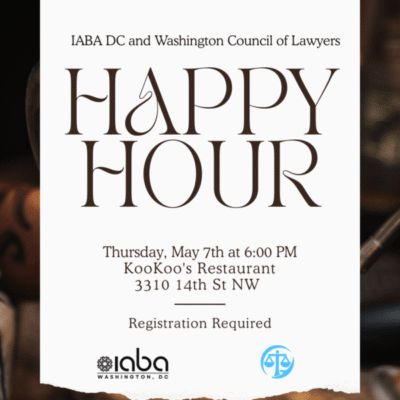
Come join IABA DC and the and Washington Council of Lawyers for a Happy Hour at KooKoo's Restaurant on May 7 at 6pm.
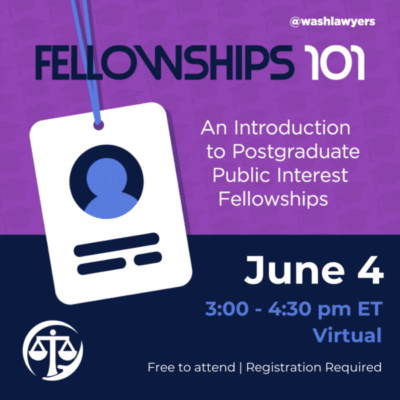
Post-graduate fellowships are a unique way to realize your ideal public interest job. Fellowships allow new lawyers to gain hands-on experience, develop project management skills, and pursue their passions for promoting justice. But the application process is complicated and the programs are competitive. We’re here to help you make sense of the process. Our expert panel will walk you through all the steps of the application procedures for the various programs and give you concrete tips for maximizing your chances of landing the fellowship of your dreams. Then, we will discuss PSJD and other online resources for finding fellowships. Finally, there will be plenty of time for individualized questions. Our conversation will be moderated by Jennie Netburn, Associate Director, Office of Public Interest and Community Service, Georgetown University Law Center Our panelists include: Charlie Gillig, Executive Director, Skadden Foundation Lauren Hartley, Associate Director of Network Engagement, Equal Justice Works Renée Schomp, Deputy Direct, Justice Catalyst Andrew Boyle, Counsel, States United Democracy Center This event is for law students at every stage of their career as well as judicial clerks and LLM students. For 3L students we will discuss the current fellowship application cycle. For 1L and 2L students, we will discuss the best ways to position yourself to receive a post graduate fellowship. We will also discuss law clerks and LLM students’ eligibility for fellowship positions. Join the conversation on social media #Fellowships101.
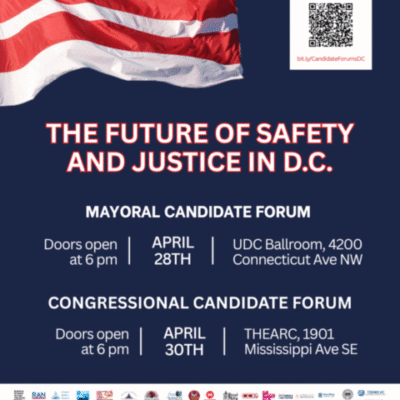
Organized by the Council for Court Excellence Join us for these important conversations on public safety and justice in D.C. D.C. Mayor: Tuesday, April 28, 2026, University of the District of Columbia, Student Center Ballroom, 4200 Connecticut Ave, NW. Metro accessible (Van Ness, Red line) and parking available with parking entrance on Van Ness Street. D.C. Delegate to U.S. Congress: Thursday, April 30, 2026 THEARC, 1901 Mississippi Ave, SE. Metro accessible (Southern Avenue, Green line), and free parking on grounds and additional street parking. Approximate schedule for both forums: Doors Open: 6 p.m. Forum: 6:30 - 8:00 p.m. Reception/Meet-and-Greet with Candidates: 8:00 - 9:00 p.m. Thank you for your interest in attending either or both of our forums, which will focus on issues affecting the systems that District residents rely on for safety and justice. On behalf of all co-sponsoring organizations, we strive to host inclusive, accessible events that enable all individuals, including those with disabilities, to engage fully. The event spaces are ADA accessible, and we will have sign language interpretation. To be respectful of those with allergies and environmental sensitivities, please refrain from wearing strong fragrances. In all situations, a good-faith effort will be made (up until the time of the event) to provide needed accommodations. Event sponsors: Bar Association of the District of Columbia - Building Bridges Across The River - Bread for the City - BreakFree Education - Center for Innovations in Community Safety (Georgetown Law) - Children's Law Center - CCE - Critical Exposure - DC Access to Justice Commission - DC Appleseed Center for Law and Justice - DC Bar’s DC Affairs Steering Committee - DC Coalition Against Domestic Violence - DC Consortium of Legal Services Providers - DC Fiscal Policy Institute - DC Justice Lab - Disability Rights DC - Festival Center - Free Minds Book Club & Writing Workshop - Hispanic Bar Association of the District of Columbia - More Than Our Crimes - Open City Advocates - Peace For DC - Reentry Action Network - School Justice Project (SJP) - Second Look Project - Thrive Under 25 Coalition - Trial Lawyers Association of DC - Tzedek DC - University of the District of Columbia David A. Clarke School of Law - Voices for a Second Chance - Volare - Washington Bar Association, Inc. - Washington Council of Lawyers - Washington Lawyers' Committee for Civil Rights & Urban Affairs
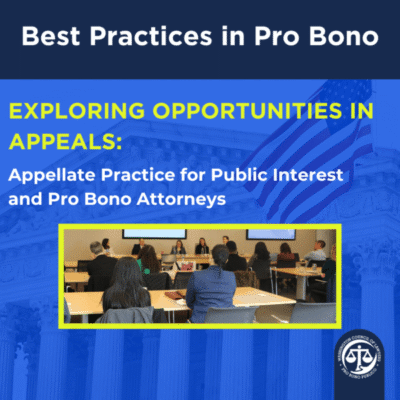
We hosted Best Practices in Pro Bono: Exploring Opportunities in Appeals: Appellate Practice for Public Interest and Pro Bono Attorneys on Wednesday, April 22, from 12:00–1:30 p.m., with generous support from Fried Frank. The goal of this discussion was to encourage participants to think broadly about pro bono opportunities in appellate practice. The conversation explored the wide range of appeals in which pro bono representation is needed, particularly in poverty law, and highlighted the many ways attorneys and non-attorneys can contribute to appellate advocacy. We also examined pipeline challenges in matching interested volunteers with cases and discussed strategies for incorporating appeals into pro bono programs.
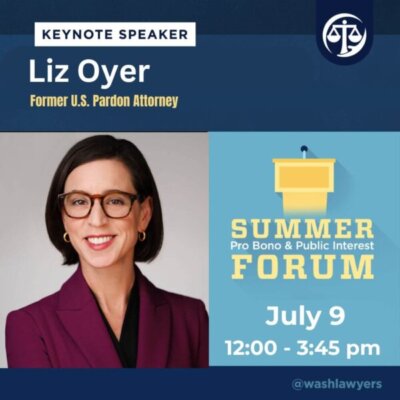
Our 2026 Summer Forum features keynote speaker Liz Oyer, former U.S. Pardon Attorney and current educator and legal contributor. From April 2022 to March 2025, Liz served as United States Pardon Attorney, the senior career official in the Department of Justice responsible for advising the President on the exercise of his constitutional clemency power. Liz’s service spanned two presidential administrations before she was abruptly fired in March 2025, as reported by the New York Times. After leaving the Justice Department, Liz created Lawyer Oyer LLC, an independent media company producing multimedia content to educate the public about threats to the rule of law, focusing on issues related to the courts, the criminal justice system, and presidential power. The Lawyer Oyer platform includes Substack, Instagram, TikTok, YouTube, and more, with over a million followers. Liz is a regular contributing guest on MSNBC, CNN, and other programs and podcasts, and a frequently quoted expert in national news publications. Liz was recently featured on 60 Minutes and in The New York Times Magazine. Liz has written for The New York Times, The Atlantic, Rolling Stone, the Washington Post, and other publications. Read more about Liz Oyer here. After the keynote remarks, we’ll offer a tasty lunch and a selection of breakout sessions where you can learn more about pro bono and public-interest work in DC and across the country. Session One (1:30-2:30 pm): Non-Litigation Pro Bono, Civil Rights & Civil Liberties, or Poverty Law. Session Two (2:45-3:45 pm): Criminal Law & Death Penalty or Immigration & Human Rights. The Summer Forum is open to Washington Council of Lawyers members (join), participants in summer associate and summer intern programs, and others interested in learning more about practicing law to benefit those in need. This event is a tradition for many summer programs because it highlights the value of incorporating pro bono or public-interest work into future legal careers. Early-bird pricing is available until June 16. There are also discounts for Washington Council of Lawyers members. Join before registering to take advantage of member pricing. Finally, if you'd like your summer associates or interns to attend, but don't yet know their names, you can register them as guests (First name: Guest 1, Last Name: Organization Name); email our Executive Director, Christina Jackson (cjackson@wclawyers.org) if you need assistance or need bulk registration. As we're fully back in-person only, we expect this event to sell out. Get your tickets early! Note: Registering for this event does not automatically make you a member. If you want to join Washington Council of Lawyers, you can do so here. If you want to take advantage of member pricing, you must join first.
We are thrilled to welcome Liz Oyer as our 2026 Summer Pro Bono & Public Interest Forum keynote speaker. Ms. Oyer served as the U.S. Pardon Attorney through two administrations until she was abruptly fired in March 2025. She spent most of her career in public service and now educates the public about threats to the rule of law, focusing on issues related to the courts, the criminal justice system, and presidential power through her Lawyer Oyer platform and guest contributions to network programming, podcasts, and national news publications.
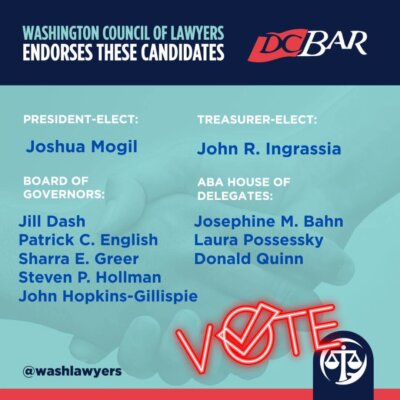
Washington Council of Lawyers endorses these 2026 candidates, listed alphabetically, and not in order of preference. Please be sure to vote! Then share our endorsements widely with your networks!