

Skip to content

Best Practices in Pro Bono: Navigating Vicarious Trauma in Pro Bono Cases: Supporting Volunteers Before, During, and After Trauma‑Intensive Work Recap

Our recent discussion focused on recognizing and responding to vicarious trauma and burnout in public interest law. Through a conversation with professionals representing legal services organizations, pro bono programs, and attorney wellness initiatives, participants learned how trauma-intensive legal work can affect attorneys, their clients, and the broader legal workplace. The discussion also highlighted practical strategies for maintaining well-being while continuing to provide meaningful advocacy.  Our panelists included: Moderator: Jen Masi, Pro Bono Director, Children’s Law Center Rena E. Cutlip-Mason, Pro Bono Immigration Attorney, AkinB  Tracy Davis, Managing Attorney, Bread for the City Niki L. Irish, LICSW, Outreach and Education Coordinator, Lawyer Assistance Program, District of Columbia Bar Ingrid Rosales Zavala, Deputy Director, Psychosocial Training & Technical Assistance, KIND The discussion began by distinguishing between vicarious trauma and burnout, two terms that are often used interchangeably but are quite distinct. The panelists explained that vicarious trauma develops through repeated exposure to the traumatic experiences of others and can fundamentally change how attorneys view their work, relationships, and the world around them.  Burnout, on the other hand, is characterized by emotional exhaustion, depersonalization, and a reduced sense of accomplishment, and can affect professionals regardless of whether their work involves trauma. While the two experiences are distinct, the panelists emphasized that prolonged exposure to trauma and frustration with difficult systems can contribute to burnout over time. The panelists then reflected on the challenges they are currently experiencing within their organizations. Several speakers acknowledged that changing legal landscapes have made the work increasingly demanding, and the outcomes less favorable than before. The panelists discussed how this can directly affect a legal team’s perspective and be quite a jarring process to some. While outcomes may not always be favorable, the discussion emphasized that attorneys continue to make a meaningful difference simply by advocating for clients and ensuring they are not navigating difficult circumstances alone.  The panel also highlighted the importance of recognizing small victories and the resilience of clients and attorneys. It can be challenging but remembering that even when a case is unsuccessful, an attorney's advocacy can still have a lasting impact on a client's experience. Attorneys focus on the legal issue but beyond it there is a life with big and small milestones alike where clients and attorneys show their resilience through celebrating, relaxing, and enjoying life. Even as the system presents increasing barriers we as people in community together can make  Another major theme of the discussion was creating healthy workplace cultures that acknowledge the emotional realities of trauma-intensive work. The speakers encouraged organizations to normalize conversations about mental health, recognize that individuals respond to stress differently, and create environments where attorneys feel comfortable asking for support. Establishing healthy boundaries, understanding one's own capacity, and maintaining open communication with supervisors and colleagues were identified as important ways to reduce the long-term effects of vicarious trauma and burnout. The panel also shared practical tools and resources available to attorneys. Participants were encouraged to utilize assistance programs, such as the DC Bar Lawyer’s Assistance Program (LAP), counseling services, and peer support as ways of proactive action, rather than reaching a breaking point and reacting to built up trauma or burn out. DC LAP provides 12 free sessions to every member of the DC Bar, these sessions are confidential. DC LAP can also connect you with someone that has been through a similar situation to you through their peer support program. Communication with the peer support person is considered attorney-client privilege and is also confidential. Learn more using the links below.  The speakers also discussed the importance of intentionally "completing the stress cycle" through practices such as physical movement, meaningful social connection, creative expression, laughter, mindfulness, and other activities that help the body recover after periods of prolonged stress. These strategies not only benefit attorneys but also help ensure they can continue providing thoughtful and effective representation for their clients. To conclude the discussion, the panelists reminded participants that resilience is built through connection. Whether through supportive colleagues, mentors, wellness resources, or simply taking time to celebrate small successes, prioritizing personal well-being ultimately strengthens the ability to serve clients. By recognizing the effects of trauma, setting healthy boundaries, and supporting one another, attorneys can build more sustainable careers while continuing to advocate effectively for those they represent. Thank you to our panelists for sharing their experiences, insights, and practical guidance. We appreciate everyone who joined us for this important discussion and look forward to continuing conversations that support the well-being of the public interest legal community. Resources: DC Lawyer's Assistance Program DC LAP Compassion Fatigue Resource Hub Burnout: The secret to solving the stress cycle by Emily & Amelia Nagosaki - this 6:58 video explains completing the stress cycle and introduces the full book by the Nagosaki sisters.

Summer Forum 2026: Non-Litigation Pro Bono Panel Preview

When we say pro bono, many think of assisting litigants through navigating the many ins and out of the court system, but that’s not the only place our legal system asks non-lawyers to have an understanding of the law. There are many opportunities for pro bono representation in transactional matters. From setting up businesses to providing tax advice, knowing the right forms and how to fill them out can make all the difference. Trained lawyers can draft wills for veterans, navigate uncontested divorce proceedings, research novel issues, and much more. If you want to support your community but hope to stay out of the courtroom, this is the panel for you! Learn more about the wide-ranging legal issues transactional attorneys can get involved with at our 2026 Summer Forum Panel on Non-Litigation Pro Bono Law on Thursday, July 9. Register here! 

Summer Forum 2026: Poverty Law Panel Preview

The legal hurdles faced by individuals living in poverty are vast. They often face uphill battles with issues impacting the most fundamental human needs: family stability, safe housing, food security, fair employment, and freedom from fear and violence. Representation is vital in these areas, and the need is overwhelming. These areas of law often have the highest rate of pro se litigants; when pro bono or public-interest lawyers get involved, these cases also produce some of the most life-changing outcomes for the parties involved. Pro bono lawyers who take on these cases literally can be life-savers. Learn more about the wide-ranging legal issues individuals living in poverty face and what pro bono opportunities are available in D.C. and across the country to help address these needs at our 2026 Summer Forum Panel on Poverty Law on Thursday, July 9. Register here!

Summer Forum 2026: Immigration and Human Rights Panel Preview

The legal landscape in America has been tumultuous for immigrants, their friends, families, and communities. This year, we have seen communities torn apart by militant and, at times, illegal action - people pulled from their homes, their jobs, their schools, or even the courthouse itself. It has been a battle for immigration attorneys to stay on top of both the changes in the law and the ever mounting need for their support as more and more people face or fear being removed from their lives. Navigating a foreign legal system is always hard, but it has become treacherous in ever developing ways. This panel will give you insight into what the field of immigration law looks like today and opportunities in which you can provide assistance. Learn more about the wide-ranging legal issues immigrants face and what pro bono opportunities are available in D.C. and across the country to help address these needs at our 2026 Summer Forum Panel on Immigration and Human Rights Panel. Register here to check out this panel at the Summer Forum!

Best Practices in Pro Bono: Navigating Vicarious Trauma in Pro Bono Cases: Supporting Volunteers Before, During, and After Trauma‑Intensive Work

Pro bono volunteers often step into moments of profound human crisis—supporting asylum seekers fleeing violence, advocating for survivors of abuse, and assisting families facing destabilizing life events. These matters frequently involve trauma, and volunteers are often navigating unfamiliar legal terrain at the same time. When attorneys are not experts in the practice area or the trauma their clients have endured, it can be difficult to recognize triggers, respond appropriately, or understand how to set boundaries that protect both client well‑being and volunteer sustainability. At the same time, volunteers bring their own lived experiences to this work. For some, the trauma embedded in pro bono cases may resonate deeply or unexpectedly, creating emotional strain that is not necessarily acknowledged openly. Many volunteers also struggle to identify or address vicarious trauma—especially when they are balancing demanding day jobs, personal stressors, and the broader pressures of the world around them. Organizations and firms face parallel challenges: When and how should they check in with volunteers? What structures, practices, or tools can meaningfully support pro bono attorneys who are straddling two professional environments? How can we build systems that normalize conversations about vicarious trauma and equip volunteers and coordinators with strategies to manage it? This panel will explore these questions from both the legal services and law firm perspectives. We will discuss practical approaches for preparing volunteers to engage in trauma-informed advocacy, supporting them while they are engaged in it, and ensuring they have resources and community after trauma-intensive work. We will also examine opportunities for developing or strengthening organizational practices that help volunteers recognize, navigate, and mitigate vicarious trauma. Join us for a candid conversation about how to support the emotional and professional well‑being of pro bono volunteers and walk away with actionable tools to put into practice for long-term volunteer sustainability. Our panel will be moderated by Jen Masi, Pro Bono Director, Children’s Law Center, in conversation with: Rena E. Cutlip-Mason, Pro Bono Immigration Attorney, Akin Tracy Davis, Managing Attorney, Bread for the City Niki L. Irish, LICSW, Outreach and Education Coordinator, Lawyer Assistance Program, District of Columbia Bar Ingrid Rosales Zavala, Deputy Director, Psychosocial Training & Technical Assistance, KIND We welcome pro bono coordinators from law firms, corporations, legal services providers, nonprofits, government agencies, and anyone who staffs pro bono projects.

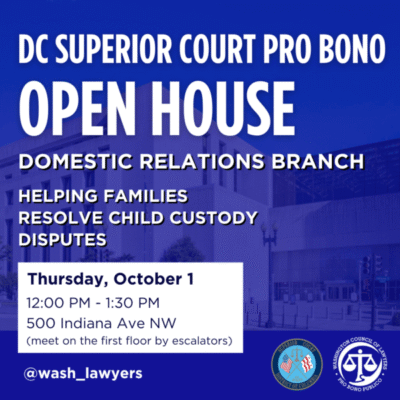
DC Superior Court Pro Bono Open House: Domestic Relations Branch

This event is hosted by DC Superior Court and Washington Council of Lawyers, and co-sponsored by the Children’s Law Center and the D.C. Bar Pro Bono Center. Join us for a DC Superior Court Pro Bono Open House! Jen Masi from the Children’s Law Center and Jenadee Nanini from the D.C. Bar Pro Bono Center will introduce you to the Domestic Relations Branch – one of the Court’s high-volume branches where pro bono representation is greatly needed in child custody cases. The Open House will focus on representing parents and third-party caregivers in child custody cases, as well serving as a guardian ad litem (GAL) representing the best interests of the children involved. Register today to learn more about how you can help a family with limited means achieve stability and enhance your professional skills through pro bono representation. Please note this event involves a moderate amount of standing and walking. The meet up location is on the 1st floor just past security on the right. If attendees have accommodation needs or questions, please contact Jodi Feldman at Jodi.Feldman@dccsystem.gov.

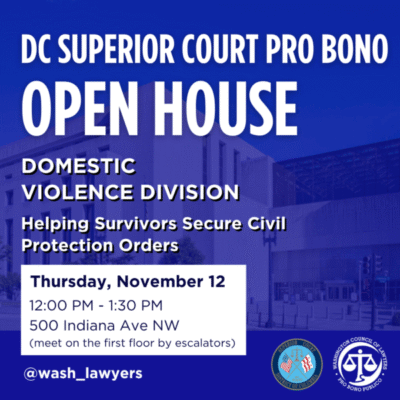
DC Superior Court Pro Bono Open House: Domestic Violence Division

This event is hosted by DC Superior Court and Washington Council of Lawyers, and co-sponsored by Volunteer Legal Advocates. Join us for a DC Superior Court Pro Bono Open House!  Alissa Osberg from Volunteer Legal Advocates will introduce you to the Domestic Violence Division – one of the Court’s high-volume branches where pro bono representation is greatly needed. The Open House will focus on representing petitioners in securing Civil Protection Orders (CPOs) against someone who has committed or threatened to commit domestic and/or sexual violence against them.  You’ll observe court proceedings, meet with judges, and find out how to get involved. Register today to learn more about how you can help someone seeking protection from violence and enhance your professional skills through pro bono representation. Please note this event involves a moderate amount of standing and walking. The meet up location for the tour is the 1st floor just past security on the right. If attendees have accommodation needs or questions, please contact Jodi Feldman at Jodi.Feldman@dccsystem.gov.

Fellowships 101 (2026)

Post-graduate fellowships are a unique way to realize your ideal public interest job. Fellowships allow new lawyers to gain hands-on experience, develop project management skills, and pursue their passions for promoting justice. But the application process is complicated and the programs are competitive. We’re here to help you make sense of the process. Our expert panel will walk you through all the steps of the application procedures for the various programs and give you concrete tips for maximizing your chances of landing the fellowship of your dreams. Then, we will discuss PSJD and other online resources for finding fellowships. Finally, there will be plenty of time for individualized questions. Our conversation will be moderated by Jennie Netburn, Associate Director, Office of Public Interest and Community Service, Georgetown University Law Center Our panelists include: Charlie Gillig, Executive Director, Skadden Foundation Lauren Hartley, Associate Director of Network Engagement, Equal Justice Works Renée Schomp, Deputy Direct, Justice Catalyst Andrew Boyle, Counsel, States United Democracy Center This event is for law students at every stage of their career as well as judicial clerks and LLM students. For 3L students we will discuss the current fellowship application cycle. For 1L and 2L students, we will discuss the best ways to position yourself to receive a post graduate fellowship. We will also discuss law clerks and LLM students’ eligibility for fellowship positions. Join the conversation on social media #Fellowships101.

Best Practices in Pro Bono: Exploring Opportunities in Appeals: Appellate Practice for Public Interest and Pro Bono Attorneys Recap

We hosted Best Practices in Pro Bono: Exploring Opportunities in Appeals: Appellate Practice for Public Interest and Pro Bono Attorneys on Wednesday, April 22, from 12:00–1:30 p.m., with generous support from Fried Frank. The goal of this discussion was to encourage participants to think broadly about pro bono opportunities in appellate practice. The conversation explored the wide range of appeals in which pro bono representation is needed, particularly in poverty law, and highlighted the many ways attorneys and non-attorneys can contribute to appellate advocacy. We also examined pipeline challenges in matching interested volunteers with cases and discussed strategies for incorporating appeals into pro bono programs.

Volunteer! D.C. Bar Pro Bono Center: Advice and Referral Clinic

Trying to find a way to fit pro bono service into your schedule? Join us for a rewarding day of service, where your skills can make a significant difference in the lives of those seeking legal guidance and support! Volunteer on Saturday,  May 30th to gain experience in serving the D.C. community in a variety of matters! At the clinic, you’ll provide brief advice (and referrals) to people who otherwise wouldn’t have access to legal help. We meet at DC Bar Building (901 4th St NW). Please arrive at 9:00 am, a brief orientation takes place at 9:15 am, and volunteers are asked to stay until the last client is seen, usually at least 3:00 pm. There’s no time commitment beyond the clinic itself. As a volunteer attorney, you’ll answer questions about consumer law, family law, housing law, public benefits, bankruptcy, and other topics. You don’t need to be an expert in these areas of law: D.C. Bar Pro Bono Center staff and expert mentors will be on hand to help. You do need to be a member of the D.C. Bar, or a federal government attorney barred in another state to participate. The deadline to volunteer is Tuesday, May 26 by 5:00 pm ET. Once you register to attend, our Program Director and volunteer coordinator, Chris Marin, will be in touch with additional details. We are currently looking for volunteers in private practice, including solo practitioners and those at firms. If you are currently a law student and would like to volunteer please contact Rachel Lawrence at lawrencera@cua.edu. Thank you!

Litigation Skills Series: Trial Advocacy

Join us at Trial Advocacy to refresh the four fundamental trial skills: Opening Statements, Direct Examinations, Cross-Examinations, and Closing Arguments.  Each topic will begin with a lecture by an expert trainer and a demonstration by skilled litigators showing how to put the lesson into practice. Then we will move to small-group breakout rooms, where each attendee will get up and practice the skill of the day. Breakout room facilitators will offer individualized, constructive feedback to each participant. Attendees should plan to spend some time between each session to prepare for the on-your-feet breakout sessions. Our fact pattern features a Domestic Relations case, but you need not know anything about substantive law in this area to benefit from the training. View the 2026 Litigation Skills Series Trial Advocacy Schedule. Given the current state of practice, which is especially demanding, we are keeping this training in a hybrid format. We hope this balances the goals of learning important skills alongside your peers without keeping you away from your clients or work for too much time! We look forward to feedback after the training! If you have any questions about the schedule, please email Chris Marin at cmarin@wclawyers.org. For Washington Council of Lawyers members, this comprehensive Trial Advocacy training costs just $165. For non-members, the cost is $265. (Join Washington Council of Lawyers to take advantage of the discounted member rates.) Scholarships are available, thanks to the generosity of the D.C. Bar Foundation, to grantee organizations. To apply for a scholarship, please complete this online scholarship form in lieu of registration. Check the list of DC Bar Foundation Grantees if you're unsure if you qualify for a scholarship. If you are working for any of these organizations when registering for Litigation Skills Series trainings, please submit your registration through the scholarship request form on the registration page. CLE credits are pending for this training for CA, NY, and NJ. REGISTRATION DEADLINE EXTENDED: Register by Monday, May 4 at 5:00 pm ET.

DC Superior Court Open House: Domestic Relations Branch

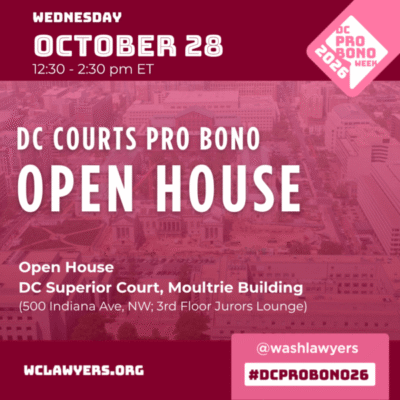
This event is hosted by DC Superior Court and Washington Council of Lawyers, and co-sponsored by the Children’s Law Center and the D.C. Bar Pro Bono Center. Join us for a DC Superior Court Pro Bono Open House! Jen Masi from the Children’s Law Center and Jenadee Nanini from the D.C. Bar Pro Bono Center will introduce you to the Domestic Relations Branch – one of the Court’s high-volume branches where pro bono representation is greatly needed in child custody cases. You’ll observe court proceedings, meet with judges, and find out how to get involved. Pro bono counsel may represent a parent, a third-party caregiver, or serve as a guardian ad litem (GAL) representing the best interests of the children involved in a custody case. Register today to learn more about how you can help a family with limited means achieve stability and enhance your professional skills through pro bono representation. Please note this event involves a moderate amount of standing and walking. If attendees have accommodation needs or questions, please contact Jodi Feldman at Jodi.Feldman@dccsystem.gov.

Best Practices in Pro Bono: Exploring Opportunities in Appeals: Appellate Practice for Public Interest and Pro Bono Attorneys

When we say pro bono service, many think of the deeply important work of helping someone navigate legal relief at the trial level. Did you know there are opportunities for pro bono service at the appellate level? In DC, appellate pro bono support is extremely important because we are one of the jurisdictions that do not have an appellate self-help center or a dedicated legal clinic focused on appeals. That means self-represented parties are left to their own devices even more at an even more complicated part of the legal process. The goal of this conversation is to encourage folks to think broadly about pro bono opportunities for appellate practice as well as provide a wide variety of examples of types of appeals where pro bono representation is needed, particularly in poverty law cases. We aim to discuss pipeline challenges and opportunities for matching interested attorneys with cases and ways that individuals who are facilitating or promoting pro bono can incorporate appeals. Our panel will be moderated by Andrea Mangones, Director of Professional Skills Support, George Mason University, in conversation with: Alex Scott, Senior Staff Attorney, Volare (Formerly Network for Victim Recovery of DC) Allison Miles-Lee, Managing Attorney, Bread for the City Jonathan Levy, Director, Barbara McDowell Appellate Advocacy Project, Legal Aid DC Peter Bruland, Senior Managing Associate, Sidley Austin LLP We welcome pro bono coordinators from law firms, corporations, legal services providers, nonprofits, government agencies, and anyone who staffs pro bono projects.

DC Superior Court Open House: Domestic Violence Division

This event is hosted by DC Superior Court and Washington Council of Lawyers, and co-sponsored by Volunteer Legal Advocates. Join us for a DC Superior Court Pro Bono Open House!  Aída Vindell from Volunteer Legal Advocates will introduce you to the Domestic Violence Division – one of the Court’s high-volume branches where pro bono representation is greatly needed.  The Open House will focus on representing petitioners in securing Civil Protection Orders (CPOs) against someone who has committed or threatened to commit domestic and/or sexual violence against them.  You’ll observe court proceedings, meet with judges, and find out how to get involved. Register today to learn more about how you can help someone seeking protection from violence and enhance your professional skills through pro bono representation. Please note this event involves a moderate amount of standing and walking. If attendees have accommodation needs or questions, please contact Jodi Feldman at Jodi.Feldman@dccsystem.gov.

Litigation Skills Series: Appellate Practice: Dos, Don’ts, and Strategies for Compelling Arguments

From complex procedural requirements, imposing briefing deadlines, and the many strategic considerations required for effective appellate argument, navigating the appeals process can be daunting. That's why it's important to fortify your appellate toolkit! Join us to learn what the appeals process entails, pitfalls to avoid, how to write more effective briefs, and musts for preparing oral arguments. This course will cover the building blocks of making the record for appeal, relevant appellate rules, and tips on effective brief writing and oral argument prep. You will leave with a deeper understanding of the appellate process and strategies that you can use in your own practice. Our faculty for this training is: Sasha Drobnick, Director of Appellate Litigation, DV LEAP, a project of Volare (formerly Network for Victim Recovery of D.C.). Register now to stride confidently into your next appeals! Scholarships are available due to the generosity of the D.C. Bar Foundation. To apply for a scholarship, please complete this online scholarship form.

Litigation Skills Series: Impeachment

Knowing how to impeach a witness can be a pivotal skill, influencing case outcomes and elevating your trial advocacy. This training features a blend of expert-led presentations, hands-on demonstrations, and dynamic workshops, enabling participants to explore the finer points of impeachment techniques. Experienced trial attorneys will share insights, best practices, and real-life examples, guiding you on how to: Identifying opportunities for impeachment Utilizing prior inconsistent statements, bias, and credibility challenges Cross-examination tactics to discredit witnesses Admissibility of impeachment evidence Effective use of exhibits and demonstrative aids This training takes place on Thursday, February 26 from 12:00 pm to 2:30 pm at Arnold & Porter (601 Massachusetts Ave NW). We will provide the drinks, cookies, and answers! You come with your lunch and questions! Scholarships are available due to the generosity of the D.C. Bar Foundation. To apply for a scholarship, please complete this online scholarship form. The following CLE credit is available for attendees of this training: CA 2.5 general, NJ 2.9 general, and NY 2.5 skills (newly admitted and experienced). We are also looking for facilitators for this training! If you are or know an attorney with 4+ years of experience that would like to give back by supporting this training, please sign up here.

Members Only: Grounded in Justice: Yoga for All Levels

Take a break from the grind and join us for a yoga class designed especially for our members. This all-levels session offers a chance to stretch, breathe, and reset—no prior yoga experience required. Balancing the demands of public service can take a toll on both body and mind. This class creates space to step away from our daily pressures and into a supportive, judgment-free environment focused on movement, mindfulness, and stress relief. Expect gentle flows, accessible poses, and grounding breathwork, with options to meet you where you are. Please bring your own mat, a standard yoga mat or beach towel works great! Come as you are, leave a little more centered—and ready to return to your work for justice with renewed energy. Motion to relax granted. Attendance is free for members. Bring a friend (separate registration is required). Space is limited, register today to reserve your spot!

Graphic: Justice After Hours social hour text in white on purple background with event details and Washington Council of Lawyers Logo and Washington Bar Association logo in the bottom left corner

Justice After Hours Social Hour

Join us for an informal networking social hour designed to foster connection, collaboration, and conversation. This relaxed gathering offers an opportunity to step away from the day-to-day demands of practice and engage with colleagues who share a commitment to service and access to justice. Whether you’re new to the public interest community or a longtime advocate, this event provides space to exchange ideas, build relationships, and strengthen the networks that support meaningful legal work. Special mocktails will be featured, and conversation is encouraged—no elevator pitch required. Come connect, unwind, and celebrate the community that makes pro bono and public interest work possible. Thank you to the Washington Bar Association for co-hosting this event!

Volunteer! DC Bar Pro Bono Center Advice & Referral Clinic

Trying to find a way to fit pro bono service into your schedule? Join us for a rewarding day of service, where your skills can make a significant difference in the lives of those seeking legal guidance and support! Volunteer on Saturday,  February 7th to gain experience in serving the D.C. community in a variety of matters! At the clinic, you’ll provide brief advice (and referrals) to people who otherwise wouldn’t have access to legal help. We meet at DC Bar Building (901 4th St NW). Please arrive at 9:00 am, a brief orientation takes place at 9:15 am, and volunteers are asked to stay until the last client is seen, usually at least 3:00 pm. There’s no time commitment beyond the clinic itself. As a volunteer attorney, you’ll answer questions about consumer law, family law, housing law, public benefits, bankruptcy, and other topics. You don’t need to be an expert in these areas of law: D.C. Bar Pro Bono Center staff and expert mentors will be on hand to help. You do need to be a member of the D.C. Bar, or a federal government attorney barred in another state to participate. The deadline to volunteer is Thursday, January 29 by 5:00 pm ET. Once you register to attend, our Program Director and volunteer coordinator, Chris Marin, will be in touch with additional details. We are currently looking for volunteers in private practice, including solo practitioners and those at firms. If you are currently a law student and would like to volunteer please contact Rachel Lawrence at lawrencera@cua.edu. Thank you!

Perspectives from the Superior Court Bench: Litigating Against Self-Represented Parties: What do Judges Want You to Know?

If you represent a client pro bono in DC Superior Court, particularly in a family law or domestic violence case, there’s a high likelihood that you’ll be litigating against a self-represented party. In cases where one side is represented by counsel and the other side is self-represented, the dynamic necessarily impacts the judge’s perspective from the bench. Join this candid conversation with Superior Court judges about what considerations come into play when litigating against self-represented parties. Judge Carmen G. McLean will moderate the discussion with: Judge Marisa Demeo Judge Ebony Scott Judge Sherry Trafford The judges will share their perspectives on topics ranging from discovery and related sanctions to the preference for making decisions on the merits, as well as their ethical responsibility to facilitate all parties being fairly heard in a proceeding. We look forward to you joining us! If you have questions for our panel, you can submit them ahead of time when you register!

Best Practices in Pro Bono: Inspiring the Next Generation: Effectively Engaging Law Students in Pro Bono Opportunities

Meeting the growing need for civil legal services requires creative strategies to engage every available resource—including law students. These enthusiastic volunteers bring energy and a desire for practical experience, but programs must balance student expectations with client needs and professional ethics. How can legal services, firms, government agencies, and the bar collaborate to attract students early, provide meaningful opportunities, and cultivate a strong pro bono pipeline? Our panel includes: Lise Adams, Pro Bono Counsel, Sidley Austin LLP Adrianne Clarke, Director of Externships and Public Interest Programming, Howard University School of Law Brooke Meckler, Community Engagement Director, Equal Justice Works Brandon Riches, Young Lawyers Division Chair, American Bar Association' Taylor Stamps, Law Student Division Chair, American Bar Association and will be joined by Jen Masi, Pro Bono Director at Children's Law Center, moderating! Join us for a candid discussion on best practices for integrating law students into pro bono work, managing their involvement effectively, and inspiring the next generation of pro bono champions.

Litigation Skills Series: Pre-Trial Discovery

Our adversarial legal system is based on arguing the facts - so it's vital to your case to get your facts straight! Join us for an engaging and practical educational training designed to strengthen your understanding of pre-trial discovery. Whether you are new to litigation or looking to refresh your skills, this session will provide a clear, structured overview of the discovery process and the strategies that can set your case up for success. Through a presentation and practice, we will examine the purpose of discovery, the tools available to practitioners, and considerations for developing an efficient, ethical, and effective discovery plan. Participants will gain insight into how discovery shapes case theory, supports negotiation, and influences case outcomes. Learning Goals: Understand the core objectives and functions of pre-trial discovery. Become familiar with the main discovery tools, including interrogatories, document requests, depositions, requests for admission, and subpoenas. Learn how to craft a strategic discovery plan aligned with case goals and client needs. Identify common challenges that arise during discovery and approaches for addressing them. Improve confidence in managing discovery timelines, obligations, and communication with opposing counsel! This training will benefit attorneys, advocates, and legal professionals seeking a stronger foundation in discovery or a more organized approach to pre-trial practice. All experience levels are welcome. Scholarships are available thanks to the generosity of the D.C. Bar Foundation. If your organization is a DC Bar Foundation grantee, please apply for a scholarship by completing this online scholarship form.

2025 Justice Impact Awards Government: Acacia Bellamy

Acacia Bellamy is an Attorney-Advisor at the US Department of Housing and Urban Development (HUD). In her position at HUD and throughout her legal career, Acacia, has demonstrated a deep commitment to her community and colleagues through her pro bono service and leadership.

2025 Justice Impact Awards Law Firm: Kate St. Romain

When it comes to pro bono service, Kate St. Romain, Partner at Fried Frank, exemplifies using her legal tools in direct representation and systemic advocacy to defend and protect her clients and community members at every level. Her incredible ability to help those in her community through innovative legal strategy is paralleled by her compassion, judgement, and leadership. While her representation has spanned across many areas of law, she works tirelessly to support survivors of domestic violence through direct representation and aims to strengthen the legal framework that protects women and families through systemic advocacy. 

2025 Justice Impact Awards Legal Services Award: Kaitlin Banner

In this past year, our neighbors and people all around the country have faced unprecedented attacks on their civil rights. Thanks to the leadership of Kaitlin Banner, the Deputy Legal Director at the Washington Lawyers’ Committee for Civil Rights and Urban Affairs (WLC), they did not need to take on that battle alone.  

DC Pro Bono Week 2025: Recap

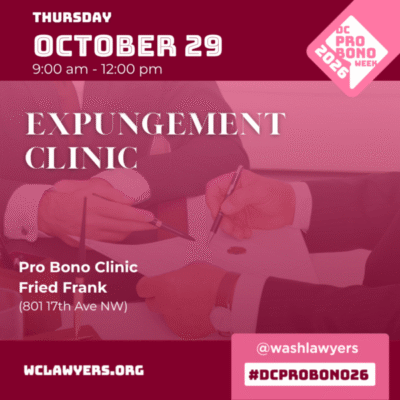
DC Pro Bono Week 2025 is a wrap! The inspiration to make a difference in our community and the celebration of pro bono service continues. We know the need for pro bono lawyers doesn’t stop and as lawyers, we have a duty and obligation to help bridge the access to justice gap. Whether it’s by taking on a pro bono case, volunteering for an advice and referral clinic, contributing to systemic advocacy, or financially supporting a legal services organization, we can all do something for the public good. Thank you to everyone who made DC Pro Bono Week possible and a special thank you to the lawyers who are Supporting Communities by helping their neighbors and moving us toward a more just and equitable society through pro bono. We also offered a wide range of events and DC Pro Bono Week programs. We kicked off the week with Pro Bono Goes Local, where D.C. Court of Appeals Chief Judge Blackburne-Rigsby and D.C. Superior Court Chief Judge Milton C. Lee Jr. discussed the need for community with DC Bar President, Sadina Montani. There were many virtual opportunities offered throughout the week, you can find the recordings for those below! We got out into the city to learn more about supporting our neighbors at Children’s Law Center Medical-Legal Partnership and at the Open Houses in DC Superior Court's Landlord/Tenant Branch, Domestic Relations Branch, and Domestic Violence Division. We also supported the 2nd Annual Walk For Justice hosted by the DC Bar Foundation! And, of course, DC Pro Bono Week would not complete without opportunities to serve. Volunteers helped folks at the Expungement Clinic, DC Bar Pro Bono Center: Advice & Referral Clinic, DC Bar Pro Bono Center: Advocacy & Justice Clinic, and The Veterans Consortium: Legal Advice and Referral Clinic. Throughout, we discovered ways to get involved, volunteer, and create positive change. With all of that, you might have missed something. Catch up on any of the programs with the following recordings: Law Student Pro Bono Service: Pathways & Programs Community Lawyering for Environmental Justice: Environmental Pro Bono Opportunities in the DC Region It Takes a Village: Highlighting the Value of Pro Bono Representation in Family Law Public Benefits: Programs and How Pro Bono Ensures their Accessibility Hot Topics Panel: Movement Lawyering and How to Support Grassroots Efforts Keep the momentum going on social media using #DCProBono25 and by doing what you can to support pro bono. Thank you for a great DC Pro Bono Week 2025!

Back To Top