


Skip to content

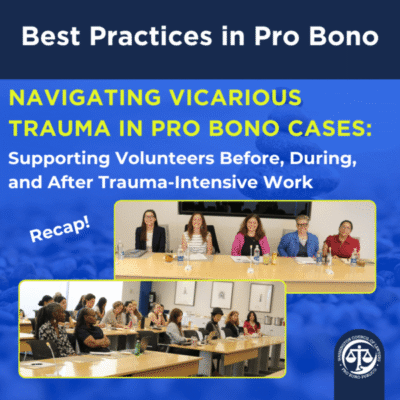
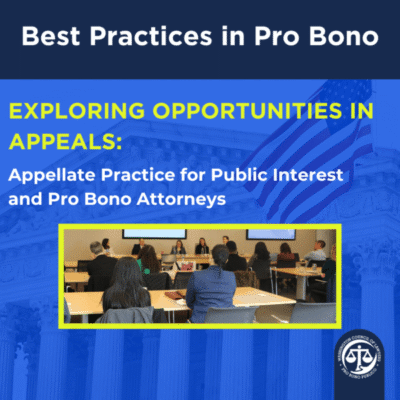
Best Practices in Pro Bono: Exploring Opportunities in Appeals: Appellate Practice for Public Interest and Pro Bono Attorneys Recap

We hosted Best Practices in Pro Bono: Exploring Opportunities in Appeals: Appellate Practice for Public Interest and Pro Bono Attorneys on Wednesday, April 22, from 12:00–1:30 p.m., with generous support from Fried Frank. The goal of this discussion was to encourage participants to think broadly about pro bono opportunities in appellate practice. The conversation explored the wide range of appeals in which pro bono representation is needed, particularly in poverty law, and highlighted the many ways attorneys and non-attorneys can contribute to appellate advocacy. We also examined pipeline challenges in matching interested volunteers with cases and discussed strategies for incorporating appeals into pro bono programs. The discussion began with panelists sharing their appellate experience and the pro bono opportunities available within their respective organizations. These perspectives highlighted the diversity of entry points into appellate work. Within legal services organizations, panelists described traditional appeals before the D.C. Court of Appeals, review proceedings at the trial court level that function similarly to appeals, and administrative proceedings before the Office of Administrative Hearings (OAH). From the law firm perspective, panelists emphasized the significant opportunities pro bono cases provide, including the possibility of arguing before the United States Supreme Court. The breadth of experiences across organizations underscored the many ways both attorneys and non-attorneys can engage in appellate work. Traditional appellate cases before the Court of Appeals remain a core avenue. Additionally, trial-level review proceedings, such as when an associate judge reviews a magistrate judge’s decision, closely resemble appellate advocacy and provide further opportunities within D.C. Superior Court. Administrative hearings also present important opportunities. These cases often arise when individuals seek to challenge changes to benefits such as Social Security or disability assistance. Proceedings are typically held before OAH, often via telephone, and may involve agencies such as the Department of Human Services or the Department of Finance. Notably, individuals do not need to be licensed attorneys to handle these cases, creating meaningful opportunities for paralegals, summer associates, and other legal professionals. The conversation then turned to how organizations evaluate whether to place a case with a pro bono partner, highlighting the flexible and collaborative nature of appellate pro bono work. Organizations generally prioritize cases that present opportunities to clarify or develop the law. Some organizations, particularly those with narrower missions, must ensure cases meet specific eligibility criteria, while others may take a broader approach to subject matter. A key consideration is whether a case should remain in-house or be supported through a pro bono partnership. These decisions are typically guided by three primary factors: expertise, resources, and community impact. Cases that fall within an organization’s core expertise and do not strain resources are more likely to be handled internally. In contrast, cases that require additional resources or fall outside the organization’s subject-matter expertise are often referred to pro bono partners. Organizations may also seek pro bono support for cases that are highly fact-specific and less likely to have broad systemic impact. As with trial-level pro bono work, appellate partnerships can take many forms. Some organizations refer cases directly to pro bono counsel while remaining available for consultation. Others adopt a co-counseling model, working closely with pro bono attorneys throughout the case. Amicus (friend-of-the-court) briefs represent another significant avenue for collaboration. In some instances, organizations retain primary responsibility for a case while engaging pro bono partners to submit amicus briefs; in others, the roles are reversed. The importance of amicus briefs, particularly at the Supreme Court level, was emphasized throughout the discussion. These briefs provide critical context about the broader implications of a case and the communities affected. Importantly, amicus briefs can influence not only decisions on the merits but also whether a case is granted certiorari. Given the rapid pace of the certiorari stage, having reliable pro bono partners prepared to contribute on short notice is essential. Panelists also highlighted additional ways to support appellate advocacy beyond direct representation. These include legal research projects, 50-state surveys, document review, case vetting, and participation in moot courts. Organizations often rely on pro bono partners to help assess the broader legal landscape and ensure their cases align with evolving legal and policy considerations. In some partnerships, law firm paralegals assist with initial intake and screening, evaluating factors such as timing, eligibility, and client needs. Moot court preparation was identified as particularly valuable. Practicing arguments before individuals unfamiliar with the specific legal issue can help sharpen advocacy by introducing fresh perspectives and critical questions. At the same time, input from subject-matter experts and those involved in legislative processes can provide important context and strengthen legal arguments. Panelists consistently emphasized that collaboration is essential in appellate work, particularly given the potential for cases to influence both individual outcomes and broader legal interpretations. The discussion also addressed several challenges associated with appellate pro bono work, with timing emerging as a central concern. While organizations can monitor cases pending before appellate courts, it is difficult to track all trial-level outcomes to identify potential appeals. Strict deadlines for filing notices of appeal can create barriers, particularly for self-represented individuals. Administrative cases may move very quickly, limiting the opportunity to engage pro bono counsel, while traditional appeals can take anywhere from six months to two years and often involve extensive records. Despite these challenges, panelists highlighted several factors that help mitigate timing constraints. Collaboration, organizational expertise, and the courts’ strong interest in ensuring representation all play important roles. Courts are often willing…

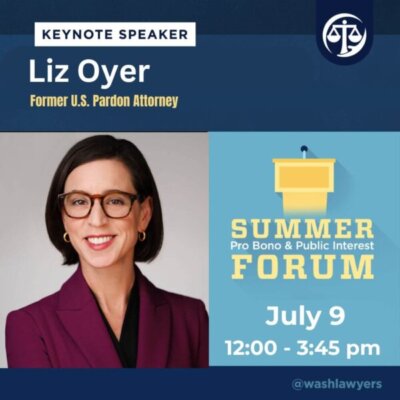
Graphic: 2026 Summer Forum Keynote Speaker Liz Oyer with date July 9, 2026 and time 12:00-3:45 pm

2026 Summer Forum Preview: Keynote

We are thrilled to welcome Liz Oyer as our 2026 Summer Pro Bono & Public Interest Forum keynote speaker. Ms. Oyer served as the U.S. Pardon Attorney through two administrations until she was abruptly fired in March 2025. She spent most of her career in public service and now educates the public about threats to the rule of law, focusing on issues related to the courts, the criminal justice system, and presidential power through her Lawyer Oyer platform and guest contributions to network programming, podcasts, and national news publications.

DC Bar Office candidate endorsements

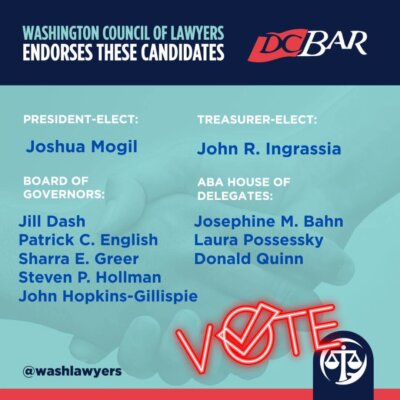
2026 D.C. Bar Candidate Endorsements

Washington Council of Lawyers endorses these 2026 candidates, listed alphabetically, and not in order of preference.  Please be sure to vote! Then share our endorsements widely with your networks!

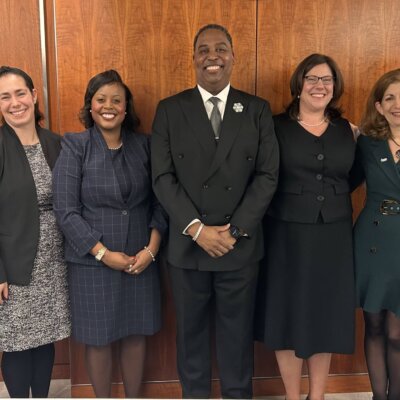
2025 Justice Impact Awards Photo Album

Thank you for joining us for a wonderful evening of inspiration and fellowship. A special thanks to our award recipients for all you do for our community! Enjoy these special memories.

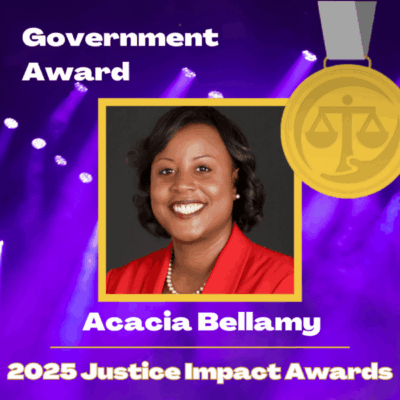
2025 Justice Impact Awards Government: Acacia Bellamy

Acacia Bellamy is an Attorney-Advisor at the US Department of Housing and Urban Development (HUD). In her position at HUD and throughout her legal career, Acacia, has demonstrated a deep commitment to her community and colleagues through her pro bono service and leadership.

2025 Justice Impact Awards Law Firm: Kate St. Romain

When it comes to pro bono service, Kate St. Romain, Partner at Fried Frank, exemplifies using her legal tools in direct representation and systemic advocacy to defend and protect her clients and community members at every level. Her incredible ability to help those in her community through innovative legal strategy is paralleled by her compassion, judgement, and leadership. While her representation has spanned across many areas of law, she works tirelessly to support survivors of domestic violence through direct representation and aims to strengthen the legal framework that protects women and families through systemic advocacy. 

2025 Justice Impact Awards Legal Services Award: Kaitlin Banner

In this past year, our neighbors and people all around the country have faced unprecedented attacks on their civil rights. Thanks to the leadership of Kaitlin Banner, the Deputy Legal Director at the Washington Lawyers’ Committee for Civil Rights and Urban Affairs (WLC), they did not need to take on that battle alone.  

Graphic: 2025 Presidents Award with headshot of Laura Klein (award recipient) in the middle framed in gold with a purple background

2025 Justice Impact Awards Presidents Award: Laura Klein

For more than twenty-three years, the name Laura Klein has been synonymous with government pro bono.  No one has had a greater or more sustained impact on the ability of federal attorneys to provide volunteer legal services.  Throughout her long career, Laura has exemplified the ideal of serving “for the public good.” Laura first received the Government Pro Bono Award from the Washington Council of Lawyers in 2004. It is fitting that at the conclusion of her distinguished federal career, she receives our 2025 Presidents’ Award, honoring her exceptional leadership, profound impact, and the generous spirit that has inspired—and continues to inspire—so many in the pursuit of justice.

2025 Justice Impact Awards Laura Klein Presidents Award Acacia Bellamy Government Award Kaitlin Banner Legal Services Award Kate St. Romain Law Firm Award Justin Loffredo Corporate Award all on purple background with gold medal at the top

2025 Justice Impact Awards Recipients

Each year, we recognize outstanding lawyers who make exceptional contributions to the pro bono and public-interest community and celebrate the hundreds of public-interest and pro bono professionals who dedicate time, expertise, finances, and compassion to helping their neighbors. We are thrilled to honor our 2025 Justice Impact Awards recipients! Read on to find out more.

Volunteer! DC Bar Advice & Referral Clinic

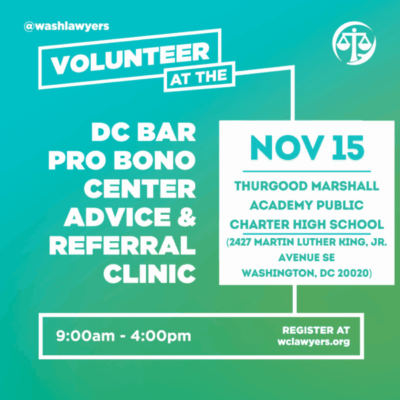
Trying to find a way to fit pro bono service into your schedule? Join us for a rewarding day of service, where your skills can make a significant difference in the lives of those seeking legal guidance and support! Volunteer on Saturday, November 15th to gain experience in serving the D.C. community in a variety of matters! At the clinic, you’ll provide brief advice (and referrals) to people who otherwise wouldn’t have access to legal help. We meet at Thurgood Marshall Academy Public Charter High School (2427 Martin Luther King, Jr. Avenue SE Washington, DC 20020). Please arrive at 9:00 am, a brief orientation takes place at 9:15 am, and volunteers are asked to stay until the last client is seen, usually at least 3:00 pm. There’s no time commitment beyond the clinic itself. As a volunteer attorney, you’ll answer questions about consumer law, family law, housing law, public benefits, bankruptcy, and other topics. You don’t need to be an expert in these areas of law: D.C. Bar Pro Bono Center staff and expert mentors will be on hand to help. You do need to be a member of the D.C. Bar, or a federal government attorney barred in another state to participate. The deadline to volunteer is Tuesday, November 11 by 5:00 pm ET. Once you register to attend, our Program Director and volunteer coordinator, Chris Marin, will be in touch with additional details. We are currently looking for volunteers in private practice, including solo practitioners and those at firms. If you are currently a law student and would like to volunteer please contact Rachel Lawrence at lawrencera@cua.edu. Thank you!

Graphic: 2025 Justice Impact Awards nominations open deadline extended over a gold ribbon with a purple background.

DEADLINE EXTENDED for Government Nominations for the 2025 Justice Impact Awards!

Annually, Washington Council of Lawyers is thrilled to celebrate us! – the hundreds of public-interest and pro bono professionals who dedicate time, expertise, finances, and compassion to helping their neighbors. Our Justice Impact Awards is a time for us to come together, recharge our collective batteries, celebrate our accomplishments, commiserate on our challenges, and be inspired. Read on to find out how to nominate a pro bono champion.

Graphic: Best Practices in Pro Bono Discussion Series

Event Recap: Full Representation in Pro Bono — Building Sustainable Support for Clients and Counsel

Our recent discussion on Best Practices in Pro Bono: Keeping the Commitment: Structures to Make Full Representation Work for Everyone brought together leaders from across the legal services, corporate, and law firm communities to explore how to make sustained, high-quality representation both achievable and rewarding for volunteers. Panelists included representatives from law firms, corporate legal nonprofit, and legal services organizations, each offering insights into what it takes to provide full representation—from the first client meeting to case resolution.

Graphic: Need Help?

Resources During the Government Shutdown

With so many federal government employees struggling during the shutdown, we've collected links to and summaries of resources available to federal employees who are furloughed. From free food to free CLE programs, many groups are trying to support those affected by the shutdown.

2025 Summer Forum Preview: Criminal Law & Death Penalty

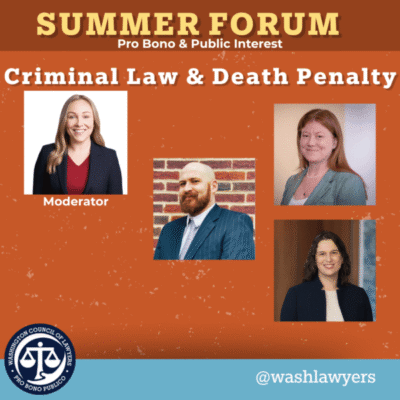
The criminal legal system remains at the forefront of national discourse, especially concerning the pervasive issues of abusive policing, mass incarceration, and the death penalty. These systemic problems not only undermine individual liberties but also perpetuate cycles of injustice and inequality within our communities. Addressing these challenges requires a deep examination of current practices and the implementation of transformative reforms to protect fundamental human rights and ensure equitable justice for all.  Learn more about these important topics at our 2025 Summer Forum Panel on Criminal Law & Death Penalty Panel on Thursday, July 10. Register here to join us!

2025 Summer Forum Preview: Poverty Law Panel

The legal hurdles faced by individuals living in poverty are vast. They often face uphill battles with issues impacting the most fundamental human needs: family stability, safe housing, food security, fair employment, and freedom from fear and violence. Representation is vital in these areas, and the need is overwhelming. These areas of law often have the highest rate of pro se litigants; when pro bono or public-interest lawyers get involved, these cases also produce some of the most life-changing outcomes for the parties involved. Pro bono lawyers who take on these cases literally can be life-savers.

Graphic: Summer Forum 2025 Keynote Representative Jamie Raskin with headshot

Summer Forum 2025: Keynote Preview

We are excited to welcome Jamie Raskin, Representative of Maryland’s 8th Congressional District in the U.S. House of Representatives, as the keynote speaker for the 2025 Summer Forum. Rep. Raskin has embarked on a life of national public service centering the progress of all people. His advocacy efforts have prioritized promoting constitutional understanding and strong democratic values in the American legal and political system.

2025 D.C. Bar Candidate Endorsements

The leadership of the D.C. Bar sets the priorities for the largest unified bar association in the country. The D.C. Bar President, Treasurer, and Board of Governors review and approve D.C. Bar policies, approve the annual budget for the Bar and the Bar Pro Bono Center, decide which committee and task force recommendations to pursue, set governance for the Bar, and much more. Washington Council of Lawyers believes effective Bar leadership will have experience in service to the legal community, have leadership experience with the D.C. Bar, D.C. Bar Pro Bono Center, or voluntary bars and be able to provide strategic guidance to contribute to the Bar’s future.

Washington Council of Lawyers Statement against attacks on the rule of law.

Washington Council of Lawyers Stands Against Attacks on the Rule of Law

As the pro bono and public-interest bar association of Washington, DC, the Washington Council of Lawyers’ core tenet is that the legal system should treat everyone fairly regardless of money, position, or power. We continue to fight against the challenges to this core principle from the administration, elected officials, and other actors.

Graphic: PIVOT! Transitioning Your Career to a New Sector event

PIVOT: Transitioning Your Career to a New Sector Resources

Transitioning out of the federal government means leaving your job with a federal agency, which typically involves assessing your transferable skills, updating your resume to highlight those skills, actively networking within your desired industry, and utilizing career transition programs like the Interagency Career Transition Assistance Plan (ICTAP) to find new employment, either within another government agency or in the private sector.  Here are some general tips you should consider during your transition:

2024 Justice Impact Awards Presidents Award recipient the Honorable Anna Blackburne-Rigsby

2024 Justice Impact Awards Presidents Award: The Honorable Anna Blackburne-Rigsby

Chief Judge Anna Blackburne-Rigsby joined the DC Court of Appeals in 2006 and has served as chief judge since 2017. Prior to her tenure at the DC Court of Appeals, Chief Judge Blackburne-Rigsby served on the Superior Court of the District of Columbia for more than ten years as an associate judge and magistrate judge. During her distinguished career, Chief Judge Blackburne-Rigsby has been honored for her legal, judicial, and community service. Moreover, she has led the Courts’ access to justice and racial equity work, steadfastly supported pro bono volunteers, and spearheaded innovative improvements to court operations. Further, Chief Judge Blackburne-Rigsby has been instrumental in the creation of the Court’s Access to Justice Unit. As the public-interest bar association of the District of Columbia, we are delighted to highlight this aspect of her work with the 2024 Justice Impact Awards Presidents Award.

2024 Justice Impact Awards Legacy Award recipient Nancy Lopez

2024 Justice Impact Awards Legacy Award: Nancy Lopez

Brilliant, dedicated, collaborator, mentor, leader. These are the words most used to describe Nancy Lopez, retired Executive Director of Washington Council of Lawyers. In her tenure, Nancy formed and shaped Washington Council of Lawyers into what we are today. Her insight, wisdom, experience, flexibility, and skill are just some of the reasons we are thrilled to recognize her with our Justice Impact Awards Legacy Award. Rarely given (it's only been awarded twice before), it is reserved for those individuals who don't just go above and beyond, but make a substantial and exemplar impact on access to justice in DC and pro bono and public interest in our community. Nancy was a stalwart leader of Washington Council of Lawyers with a passion for our mission and an unwavering commitment to access to justice work. We were fortunate to have her hand at the helm through unprecedented growth and once-in-a-lifetime challenges. She continues to support our work as a volunteer, and her vision lives on in the work we do every day. Join us in celebrating Nancy Lopez as our Legacy Award recipient.

Graphic: 2024 Justice Impact Awards Government recipient Christine Ennis

2024 Justice Impact Awards Government: Christine Ennis

Christine Ennis is a trial attorney in the Environmental and Natural Resources Division (ENRD) of the U.S. Department of Justice (DOJ) who has demonstrated a laudable commitment to performing and empowering others to engage in pro bono service. From the major efforts and achievements to the smaller tasks that ensure she and her colleagues can continue to provide innovative pro bono service to her neighbors, Christine has made a tremendous positive impact on her community. For these and many more reasons, we're excited to celebrate Christine Ennis as the 2024 Justice Impact Award Government recipient.

2024 Justice Impact Awards Legal Services recipient Amy Nelson

2024 Justice Impact Awards Legal Services: Amy Nelson

Amy Nelson, Director of Legal Services for Whitman-Walker Health, has spent her career working for justice and improving the lives of low-income people and those impacted by structural barriers. Amy deeply cares about people – her clients, her team, all relationships. She leads with humanity and enthusiasm.  She centers everyone’s unique needs and feelings as she works to lead, support her team, reduce structural barriers, and improve access by truly seeing the person. Colleagues use words like kind, brilliant, and persistent. Amy is a deeply respected leader in our community who always seeks ways to increase access to justice for marginalized individuals. She is a mentor, supporter, collaborator and innovator. Most importantly she is tireless in pursuing justice for her clients and building networks to multiply her impact. For these reasons and more, we are pleased to honor Amy Nelson with the 2024 Justice Impact Awards Legal Services award.

Graphic: Kathi Westcott recipient of the 2024 Corporate Legal Department Justice Impact Award

2024 Justice Impact Awards Corporate Legal Department: Kathi Westcott

Kathi has worked tirelessly to expand opportunities in the legal profession to all, through her active leadership of the Chapter’s diversity, equity and inclusion efforts and many other initiatives. Kathi is a visionary leader who has shown a remarkable commitment to justice in our legal community. She is a force multiplier, not only providing legal services directly to clients, but encouraging and inspiring others to do so as well. We are thrilled to recognize Kathi Westcott with our 2024 Justice Impact Awards Corporate Legal Department award.

Back To Top